What if culture, intelligence and education did not make us wiser, but made us more prone to error? In the USSR, university graduates were two to three times more likely to support the Communist Party than those who only finished secondary school1. White collar professionals held far more favourable views of communist ideology than agricultural labourers and semi-skilled workers2. In Cambodia, the Khmer Rouge, responsible for the murder of nearly two million of their fellow citizens, were led by eight French-speaking intellectuals: five teachers, a university professor, a civil servant, and an economist. All had studied in France in the 1950s, several of them at the Sorbonne, where they absorbed Jean-Paul Sartre’s ideas on political engagement and on the necessity of revolutionary violence3. In the West, many leading intellectuals became fellow travellers of the Soviet regime, from Sartre himself (”A revolutionary regime must rid itself of a certain number of individuals who threaten it, and I see no other means than death. One can always get out of a prison4“) to Bertolt Brecht (who said of those executed during the Moscow trials: “The more innocent they are, the more they deserve to be shot5“) or Bernard Shaw (“We are duping and doping ourselves by reckless abuse of Stalin just as we used to in the cases of Voltaire and Washington”6). The list goes on: Althusser, Aragon, André Glucksmann, Edgar Morin, Noam Chomsky...
Upon his return from the Spanish Civil War, George Orwell could not persuade a single influential journal to publish his account of the purges, tortures, and executions committed by the Spanish Communist Party - because of the British intelligentsia’s tacit sympathy for communism7. For the same reasons, he later struggled to find a publisher for his anti-totalitarian satire Animal Farm (T. S. Eliot, then a director at a major publishing house, rejected the manuscript, complaining that Orwell had not presented the “Trotskyist point of view” sympathetically enough8). “The English intelligentsia, wrote Orwell in the book’s preface, has developed a nationalist loyalty towards the USSR, and in their hearts, they feel that to cast any doubt on the wisdom of Stalin is a kind of blasphemy9.” In the 1930s, on the other side of the Atlantic, Ayn Rand suffered a similar fate. After fleeing post-revolutionary Russia for the United States, she wrote a novel (We the Living) depicting everyday life under the Bolshevik regime. For three years, New York publishers turned her down on ideological grounds. “It is an excellent book,” her agent reassured her. “The problem, of course, is that it has an anti-communist tone. And most American publishers sympathize with Trotskyism10.”
As for Nazism - endorsed by figures such as Martin Heidegger or Carl Schmitt - it found some of its most eager supporters among Germany’s intellectual elite. At the Wannsee Conference, the mechanics of industrial mass murder were debated with academic rigor in a room where more than half the participants held PhDs. During his rise to power, writes the historian Paul Johnson, Hitler
“consistently was most successful on the campus, his electoral appeal to students regularly outstripping his performance among the population as a whole. He always performed well among teachers and university professors. Many intellectuals were drawn into the higher echelons of the Nazi Party and participated in the more gruesome excesses of the SS. Thus, the four Einsatzgruppen or mobile killing battalions which were the spearhead of Hitler’s ‘final solution’ in Eastern Europe contained an unusually high proportion of university graduates among the officers. Otto Ohlendorf, who commanded ‘D’ Battalion [responsible for the murder of 33,721 Jews in two days], for instance, had degrees from three universities and a doctorate in jurisprudence11”.
In the United Kingdom, Orwell observed, the intelligentsia was “more wrong about the progress of the war than the common people”, more likely to be “swayed by partisan feelings12”. The average intellectual for instance believed “that the war was lost in 1940, that the Germans were bound to overrun Egypt in 1942, that the Japanese would never be driven out of the lands they had conquered, and that the Anglo-American bombing offensive was making no impression on Germany13”. Had British intellectuals done their work with a little more diligence, Orwell concluded in another text, “Britain would have surrendered in 194014.” Consider what Bertrand Russell, arguably one of the 20th century’s most brilliant minds, said in the 1930’s: “Britain should disarm, and if Hitler marched his troops into this country when we were undefended, they should be welcomed like tourists and greeted in a friendly way. It would take the starch out of them, and they might find some interest in our way of living15.” In his famous book The Treason of the Intellectuals (La Trahison des clercs), Julien Benda documents the the intellectuals’ pre-war fascination with totalitarianism, the way many abandoned the pursuit of truth to become servants of regressive ideologies. The irony: Julien Benda himself, two decades later, justified some of the communist executions in the USSR16.
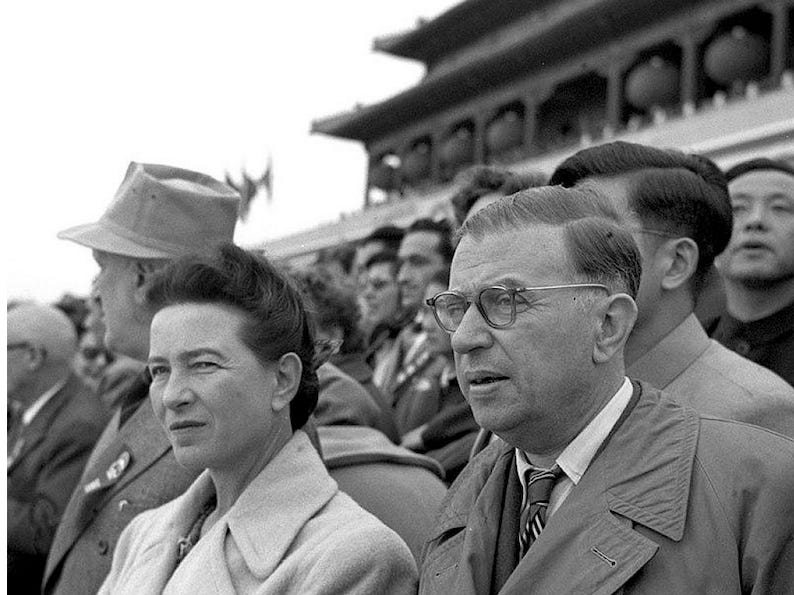
In the second half of the twentieth century, political lucidity remained a scarce commodity among the French intelligentsia. Fidel Castro received visits from Agnès Varda (who directed a propaganda film comparing him to Gary Cooper), from Sartre (who wrote sixteen laudatory articles about him for France-Soir), or from Simone de Beauvoir (who described the Cuban dictator as a gifted and benevolent philanthropist17). This was not, incidentally, her first flirtation with totalitarianism. A few years earlier, she had travelled to China, only to publish, upon her return, a five-hundred-page book glorifying Maoism. “The policies implemented by the regime, she analysed, are those that any modern and enlightened government, intent on advancing its country, should adopt18.” “Freedom, she wrote, was a very concrete reality” in China, while in the West it had become an illusion, worn away by “conformism” and “individualism19”. She dismissed as a bourgeois fabrication the idea that China was a dictatorship.
“Mao’s official position carries only limited power. His personal prestige - his qualities, his competence - nevertheless ensure him a preponderant role. In particular, since 1927 he has been the undisputed expert on peasant questions. But the power he exercises is no more dictatorial than that held, for example, by a Roosevelt. The Constitution of the new China makes it impossible for authority to be concentrated in the hands of a single person: the country is governed by a team whose members are united by a long common struggle and close camaraderie20.”
Beauvoir praised the “inimitable naturalness” of the Great Helmsman and of his minister Zhou Enlai, which she attributed “to their deep peasant roots, and to the serene modesty of men too engaged in the world to worry about their appearance.” She insisted: “Whether powerful or subtle, their faces express an extraordinary personality. They do not merely charm; they inspire something very rare: respect21.” As is now well known, Mao was responsible for between forty and eighty million deaths, making him perhaps the greatest mass murderer in human history. This intellectual blindness persisted for quite some time. As late as 1974, Roland Barthes, back from China, published a travel account. He described a “peaceful” country, wrote of its “complex cuisine,” and of “children you never tire of watching, their expressions so varied.” Not a word about the country’s harsh living conditions. His conclusion: “In the streets, in workshops, schools, on country roads, a people (who, in twenty-five years, have already built a considerable nation) move about, work, drink their tea or do their solitary exercises—without theatre, without noise, without posing; in short, without hysteria22.” If Barthes felt not the slightest indignation about life in China, he did about the meal served on his flight home…: “The lunch is so disgusting (little rolls like pears, limp chicken in greasy sauce, colourful salad, cabbage with chocolatey starch- and no champagne!) that I’m on the verge of writing a letter of complaint23.”
Two decades later, Sartre hailed the Iranian Islamic Revolution, as did Michel Foucault, who described with a certain naïveté the progressive policy he believed the mullahs’ regime would pursue:
“By ‘Islamic government,’ no one in Iran means a political regime in which the clergy would play a leading or supervisory role. [...] One can find in the Quran general guidelines: Islam values work; no one can be deprived of the fruits of their labour; what must belong to all (water, the subsoil) shall not be appropriated by anyone. Freedoms will be respected insofar as their exercise does not harm others; minorities will be protected and free to live as they please on condition that they do not injure the majority; between man and woman, there will be no inequality of rights, but difference, since there is a difference in nature. In politics, decisions will be taken by majority rule; leaders will be accountable to the people; and everyone, as provided for in the Quran, will be able to stand up and demand an account of those who govern24.”
If posterity isn’t kind to some of the great thinkers of the last century, who knows what fate it has in store for our intellectuals? Today, the American political scientist David Shor observes that “highly educated people tend to have more […] extreme views than working-class ones. We see this in issue polling and ideological self-identification. College-educated voters are way less likely to identify as moderate25“. What is more, it is often within the university (the quintessential home of the intellectual elite) that certain regressive ideas incubate and undermine social cohesion26. “On matters of general interest, wrote French philosopher Gustave Le Bon in the nineteenth century, the opinion of specialists in letters or science is worth no more than that of the ignorant—and very often much less. It is very often on the side of the crowd, and rarely on that of the specialists, that one finds political sense, patriotism, and concern for the defense of social interests27.”
Why does a society’s elite so often grow enthusiastic about absurd ideas, fall prey to passions that, years later, prove to have been not only retrograde but also contrary to the most elementary common sense? The answer to this question matters, because the ideological fads of intellectuals, unfortunately, do not always remain mere theoretical ramblings. It is the question my book sets out to answer.
You can read chapter 1 here for free. Or order the book (in French, but several translations coming soon !) here.
Pereira, N. G. O., et Pereira, L. H. (2003), « Work ethics and the collapse of the Soviet system », Canadian Slavonic Papers, 45 (1-2), p. 61-94. Pointed out by Rob Henderson in “Why Dumb Ideas Capture Smart and Successful People”, Substack, 19 November 2023.
Ibid
P. Johnson, Intellectuals, Harper Collins, 1992 (1988), p. 246.
Interview with the magazine Actuel, 28 February 1973. He added: “The revolutionaries of 1793 probably didn’t kill enough.”
Quoted in J.-F. Revel, La Connaissance inutile, Grasset, 1988, p. 338.
Open letter published in the New Statesman, 31 May 1941.
O. Clarke, “Orwell’s battle with the intelligentsia,” The Orwell Society, November 2015.
A. Flood, “TS Eliot’s rejection of Orwell’s Animal Farm,” The Guardian, May 2016.
G. Orwell, “The Freedom of the Press” (1945), in The Times Literary Supplement, September 1972.
R. Ralston, “Publishing We The Living,” New Ideal, 22 March 2024.
P. Johnson, Intellectuals, p. 319.
G. Orwell, “Notes on Nationalism,” 1945, in Notes on Nationalism and Other Essays, Penguin, 2018, pp. 28–29.
Ibid.
G. Orwell, “Antisemitism in Britain,” 1945, in the same collection, p. 42. (“I do not think it an exaggeration to say that if the ‘intellectuals’ had done their work a little more thoroughly, Britain would have surrendered in 1940.”)
Quoted in J.-F. Revel, La Connaissance inutile, p. 326. Originally quoted in “50 years ago”, The International Herald Tribune, 2 April 1987.
J.-F. Revel, Mémoires, Bouquins, 2018 (1997), p. 26; J.-F. Revel, La Connaissance inutile, p. 327.
“Archives : Simone de Beauvoir parle de Fidel Castro,” Le Nouvel Obs, December 2016.
S. de Beauvoir, La Longue Marche, Gallimard, 1957, p. 484.
Ibid., p. 480.
Ibid., p. 416.
Ibid., p. 417.
R. Barthes, “La Chine, comme l’a vue Roland Barthes”, Le Monde, 24 may 1974
Quoted by S. Leys, “Roland Barthes in China“, in The Hall of Uselessness: Collected Essays, NYRB Classics, 2013
M. Foucault, Dits et écrits, vol. III, 1976–1998, Gallimard, 2001, p. 692.
E. Levitz, “David Shor on Why Trump Was Good for the GOP and How Dems Can Win in 2022,” New York Magazine, March 2021. Pointed out by Rob Henderson in “Why Dumb Ideas Capture Smart and Successful People”, Substack, 19 November 2023. David Shor adds that within the Democratic Party, white voters—because on average they are the most highly educated—are now “the furthest left on almost every issue: taxes, health care, policing, and racial questions.”
H. Pluckrose and J. Lindsay, Cynical Theories, Pitchstone, 2020.
G. Le Bon, Psychologie du socialisme, La Délégation des siècles, 2021 (1899), pp. 72–73.